
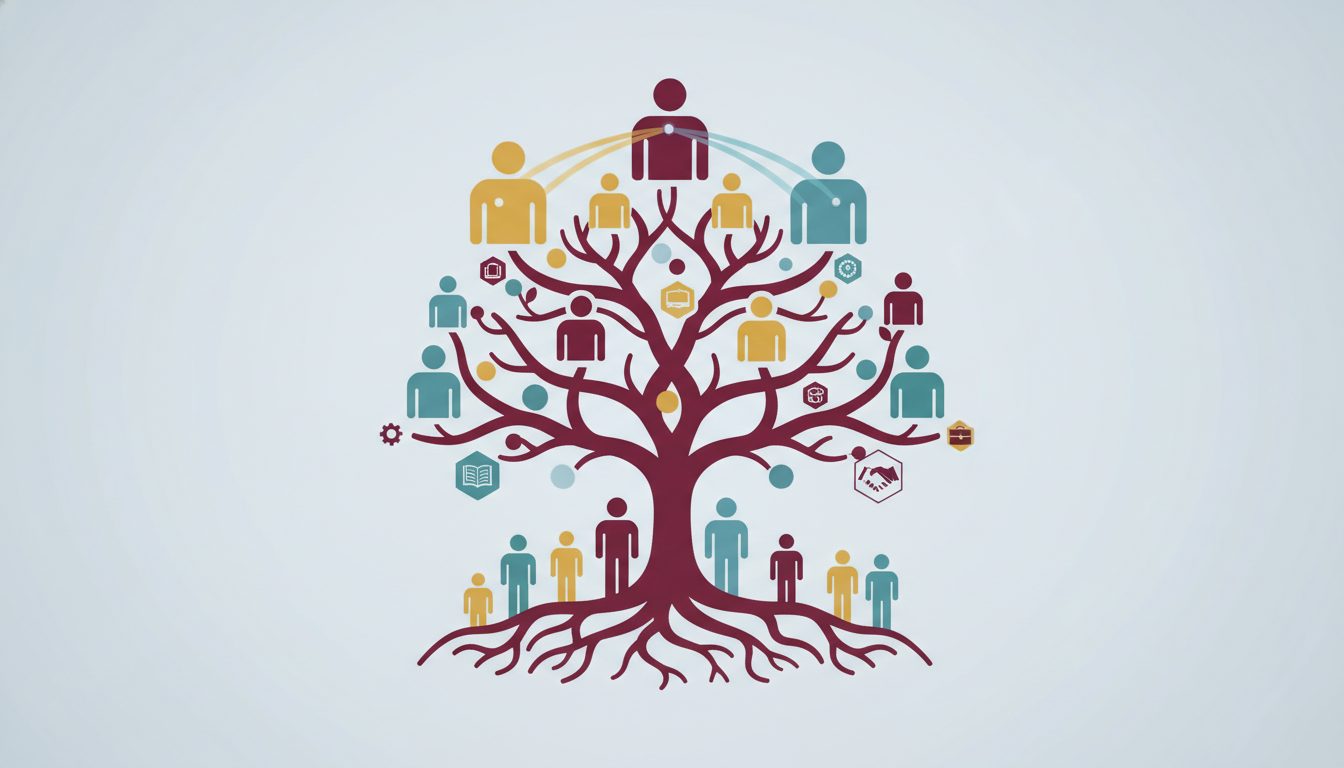
In a nutshell: the age pyramid and the acceleration of AI are presenting companies with a dual challenge: preserving the tacit knowledge of older employees before they leave, while preparing younger generations to draw on this living memory. Here are the points to remember:
- Nearly one in four employees in France is over 55, with a risk of losing 30% of critical knowledge if they do not take early retirement (source: OECD).
- Tacit knowledge resists conventional documentation: it requires living methods (mentoring, video, pairing).
- Effective knowledge management combines tools, rituals and recognition of the role of transmitter.
- An alumni platform extends the transmission beyond the employment contract.
- The 5 methods presented can be activated this week, without having to overhaul your entire HR policy.
Every year, companies lose irreplaceable experts due to the lack of a structured knowledge management process. This article details 5 concrete methods for documenting seniors ‘ tacit knowledge and building a genuine organizational memory. For HR and management, this is often the difference between successful knowledge capitalization and a silent hemorrhage of skills. According to the OECD, up to 30% of expertise capital can be lost through unprepared departures: an invisible but very real cost for thecompany.
Why documenting seniors’ tacit knowledge has become vital
Documenting the tacit knowledge of senior employees secures business continuity, avoids dependence on a few experts and transforms individual experience into a collective heritage. Today, this is a strategic priority in the face of the mass departure of baby-boomers and the rise of AI, which does not replace business intuition, but can amplify it if captured.
The 2026 context is unequivocal: France is going through a historic wave of retirements, with sectors such as industry, construction, energy and healthcare in the front line. A maintenance technician who can recognize a breakdown by the sound of a machine, a salesperson who can sniff out a high-risk customer, an engineer who can anticipate a flaw in a protocol: these skills are not to be found in any manual. They live in gestures, intuitions and reflexes accumulated over 20 or 30 years.
Risk is not limited to technical loss. It also affects corporate culture, relational codes and the memory of past decisions. When a senior employee leaves without passing on his or her knowledge, a whole history is lost. And with the massive arrival of generative AI in workflows, companies that fail to formalize their experience capital will find their new tools running on empty for lack of quality business data to exploit.
The intergenerational challenge is therefore twofold: to preserve what already exists and to create the conditions for a fluid dialogue between the generations. Young people bring their digital agility, while older people bring their professional depth. A well-designed platform bridges the gap. For a more in-depth look at the strategic dimension, the knowledge management strategy guide details the overall approach.
The hidden cost of non-transmission
An industrial SME in Eastern France saw its maintenance manager leave after 32 years with the company. In six months, the breakdown rate doubled and repair times tripled. Why was this? Nobody knew the mental map of the equipment he had built up. This case illustrates a reality: the cost of an ill-prepared departure far exceeds the salary to be replaced. We’re talking about degraded quality, weakened customers, and sometimes safety risks in demanding industrial environments.
Method 1: Organize structured intergenerational mentoring
Structured mentoring remains the most powerful method for transferring tacit knowledge, as it is based on real-life situations. A senior-junior pairing, followed over 6 to 12 months with clear objectives and regular rituals, circulates far more knowledge than any documentary database can capture.
In concrete terms, the system is based on three pillars: a charter clarifying roles, a schedule of meetings (ideally twice monthly), and a progressive deliverable (logbook, key action sheets, co-produced video clips). The senior is no longer just a know-it-all: he becomes a facilitator. The junior is no longer just a learner: he documents what he observes as he goes along.
A training manager at an energy group has deployed a mentoring program targeted at engineers nearing retirement. The result after 18 months: 47 formalized job descriptions, 12 short videos distributed internally, and, above all, a dozen juniors who have in turn become transmission relays. The subject is documented in greater detail in the mentoring programs dedicated to expertise.
AI can support this system, by automatically transcribing exchanges, summarizing points discussed and suggesting missing themes. It never replaces the human element, but frees up time for what really counts: the relationship. To explore the link between mentoring and knowledge transfer, see this dedicated analysis.
Conditions for successful pairing
A pairing works when both profiles are willing, when their hierarchy officially recognizes the time devoted, and when an HR adviser monitors their progress. Otherwise, the system runs out of steam in a matter of weeks. We also have to accept a simple truth: not all seniors are born teachers. It’s better to select those who enjoy passing on knowledge than to impose the role on everyone.
Method 2: Capturing tacit knowledge through video and storytelling
Short video is the most effective weapon for capturing what the written word can’t say. Filming a gesture, a posture or an oral explanation takes 5 minutes, whereas a written manual would take 50. And the result is watched ten times more by the teams.
The winning format: capsules of 3 to 8 minutes, shot in the field with a smartphone and a tie microphone. No need for professional production. Authenticity takes precedence over aesthetics. The senior shows, explains, shares an anecdote. The filming itself becomes a moment of transmission, often in the presence of the future successor.
The practice story is a powerful variant: the senior is asked to recount a difficult situation, how he or she resolved it and what he or she gained from it. These stories anchor knowledge in concrete terms. They are more easily transmitted than abstract procedures, because the human brain retains stories, not bulleted lists.
| Format | Ideal duration | Type of knowledge captured | Target audience |
|---|---|---|---|
| Craft gesture capsule | 3-5 minutes | Technical know-how | Operators, technicians |
| Practice story | 10-15 minutes | Soft skills, case management | Managers, sales representatives |
| Senior/junior cross-interview | 15-20 minutes | Business vision, culture | All audiences |
| Step-by-step tutorial | 5-10 minutes | Complex procedure | New arrivals |
| Project feedback | 20-30 minutes | Lessons learned | Project teams |
In community platform projects supported by alumni animation specialists, we regularly observe that videos produced by seniors themselves (with minimal framing) generate 3 to 5 times more views than polished institutional content. Proximity creates trust, and trust creates usage.
Method 3: Map critical knowledge before it’s too late
Mapping critical knowledge involves identifying, upstream of departures, which skills are strategic, who holds them, and at what level of risk. It’s the compass without which no serious documentation process can succeed.
The basic tool: a matrix cross-referencing knowledge criticality (impact on business) and fragility (number of holders, departure horizon). Knowledge held by a single person 18 months before retirement is in the red zone. Those mastered by several employees are in the green zone. This simple visualization guides action priorities.
The technical director of a construction company carried out this exercise with his management committee. The verdict: 23 skills in the red zone, 7 of which were totally undocumented. Within six months, the company had secured 18 of them through a mix of mentoring, video and practical sheets. This sector-specific subject is explored in this dossier dedicated to senior departures in the construction industry.
This mapping must live on. It should be updated every year, ideally during performance reviews. It feeds into the GEPP and succession planning. Without it, documentation is haphazard, efforts are scattered and the essential is forgotten.
Questions to ask when mapping
Four questions are enough to get you started: Who holds this knowledge? How many people really master it? What would be the operational impact if this person left tomorrow? When is this departure likely? In just a few weeks, the answers, gathered from managers, will provide a valuable map. For transmission methods specific to research environments, consult this resource on laboratories.
Method 4: Ritualize feedback and communities of practice
Communities of practice are regular forums where professionals in the same profession share their cases, difficulties and tips. When they include seniors and juniors, they become natural transmission gas pedals, without the cumbersomeness of a formal system.
The typical format: a monthly 90-minute meeting, led by a facilitator, around a real-life case brought in by a participant. Everyone reacts, makes suggestions and recounts a similar situation. What is learned is recorded in a shared space accessible to all. Over the course of a year, a gold mine is created.
Post-project feedback (REX) plays the same role on a project scale. After each major project, we take 2 hours to answer three questions: what worked, what didn’t, what are we going to do differently? Properly documented, this REX becomes a reference for subsequent teams.
A recurring operational observation in professional community projects: a network only works in the long term if it offers more than just a directory. The platform facilitates thematic exchanges, targeted events, mentoring and the circulation of opportunities. This is precisely the promise ofa comprehensive alumni platform, which extends the link beyond the employment contract and activates the transmission between old and new.
Method 5: Extend transmission via the alumni network and skills volunteering
The corporate alumni network turns former employees into a living resource for current teams. A retired senior employee can continue to pass on his or her knowledge through occasional mentoring, training sessions or contributions to the knowledge base. It’s a direct response to the challenge of intergenerationalinnovation.
A dedicated platform structures this link: it brings together alumni, promotes their career paths, offers mentoring spaces, organizes events and shares opportunities. It anchors a culture of care and development, proves a coherent employer brand, and concretely demonstrates that the company extends its responsibility beyond the exit. It’s also a strong CSR act: passing on skills, intergenerational inclusion, supporting employability, volunteering expertise, combating the waste of knowledge.
The benefits are measurable: participation in events, hours of mentoring, formalized feedback, successful co-optations. In terms of attractiveness, the effect is powerful: candidates see a company that doesn’t let go of its employees once they’ve left. On the HR side, you have a pool of potential re-hires, mentors and one-off trainers. For more on the retirement-knowledge link, see post-retirement strategies and, for technical sectors, preventing the loss of maintenance expertise.
Activate the alumni system
Three actions to be launched this week: identify former employees ready to stay in touch, define a simple contribution format (mentoring 2h/month, one-off intervention, document proofreading), choose an internal pilot to lead the network. Once the momentum has been set in motion, the benefits are self-evident. Highly technical sectors will find specific leads in this guide for the energy sector and this resource for the manufacturing industry.
What you remember:
- Documenting seniors’ tacit knowledge is no longer optional: it’s a condition of survival in the face of the age pyramid and AI.
- The approach is structured around five complementary methods: structured mentoring, video and storytelling, critical knowledge mapping, communities of practice and an active alumni network.
- Efficiency relies on a trio of lightweight tools, regular rituals and official recognition of the role of transmitter.
- An alumni platform transforms transmission into a sustainable strategic asset, at the crossroads of HR, CSR and employer branding.
- The right time to start is now: every month lost is expertise evaporated.