
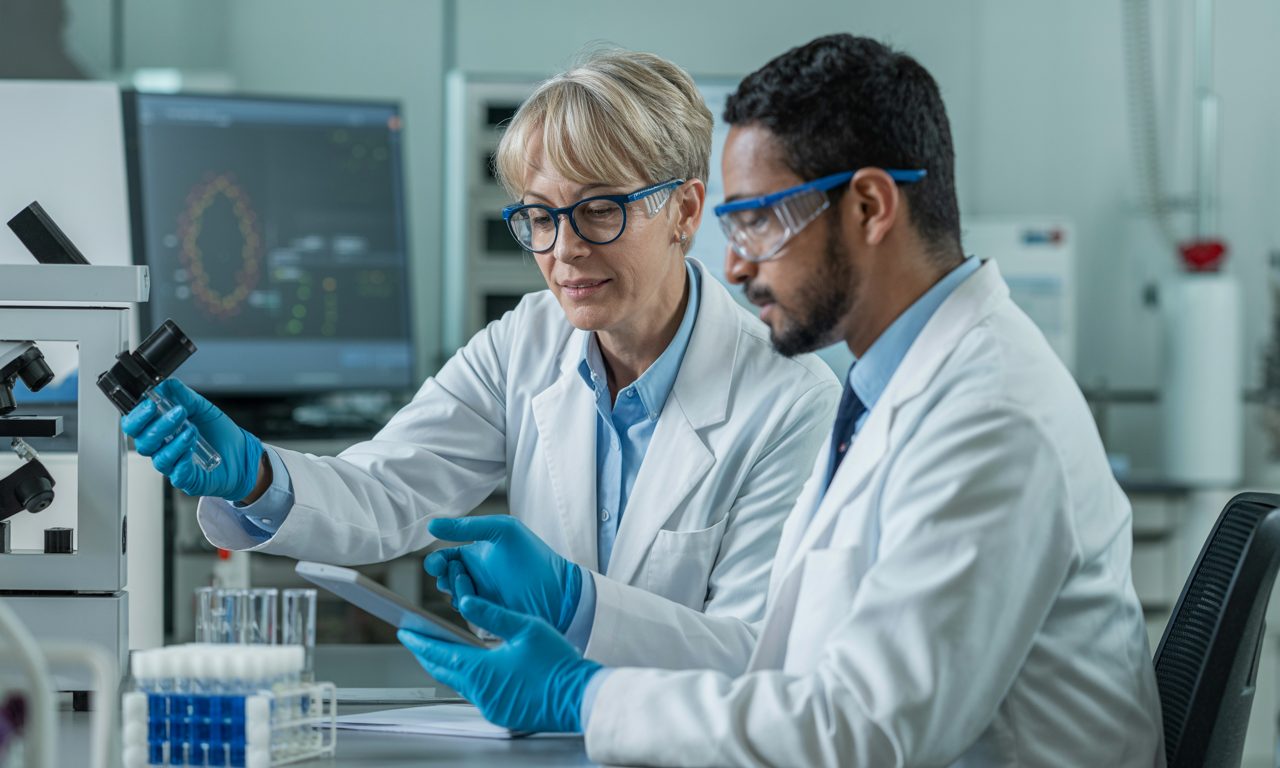
In pharmaceutical laboratories, each departure of a senior member of staff brings with it years of mastered protocols, implicit decisions and tacit adjustments that no book of procedures will ever fully capture. Knowledge transfer is not a luxury for large companies: it’s a prerequisite for operational, regulatory and competitive survival.
Pharmaceutical companies’ experience capital: a fragile resource
A senior technician who retires after twenty years on a sterile production line doesn’t just leave behind a vacant post. He leaves behind a cognitive void: reflexes acquired in the face of analytical drifts, an instinctive reading of chromatographic anomalies, a memory of incidents resolved outside official documentation. This capital of experience is all the more precious in that it is invisible until the day it disappears.
Pharmaceutical laboratories are under double pressure. On the one hand, regulatory authorities (EMA, FDA, ANSM) demand absolute traceability of processes, demonstration of continuous control and robustness of analytical transfers. On the other hand, the demographics of the workforce are accelerating turnover: waves of retirements, inter-departmental mobility and increasing outsourcing. Knowledge management is thus becoming as much a compliance issue as a performance lever.
Research into knowledge management at pharmaceutical production sites shows that the most resilient organizations are those that treat knowledge as an asset to be managed, rather than as an implicitly available resource. Waiting for an expert to leave to formalize what he knows is already too late.
Capitalizing on skills: concrete methods to ensure that nothing is lost
Capitalizing on skills is based on a simple principle: make explicit what is tacit, before the holder of the knowledge is no longer available to pass it on. In a laboratory, this involves several levels of formalization.
The first level is enriched scientific documentation. In addition to standard operating procedures (SOPs), laboratories would do well to produce “reasoning sheets”: documents that explain not only the what, but also the why of a protocol. Why this storage temperature? Why this analytical rejection threshold? These decisions, often the result of painful experience, are not included in any ICH guidelines. A methodical approach to securing and managing knowledge makes it possible to structure this collective memory without unnecessarily burdening the quality system.
The second level involves the workflows themselves. Mapping critical processes – method transfer, equipment qualification, OOS management – with the people who master them, helps identify points of human dependency. A single expert mastering a key stage without an identified backup represents a concrete operational risk. Laboratory workflow reliability tools help to visualize these areas of fragility and plan corrective action before a crisis occurs.
Structuring a knowledge transfer plan in a pharmaceutical lab
An effective knowledge transfer plan cannot be improvised six months before the departure of an expert. It must be built over a period of twelve to eighteen months, with milestones and clearly assigned responsibilities. The complete guide to knowledge transfer details this architecture in successive phases: identification of critical knowledge, selection of the transmitter-receiver pair, documented co-practice sessions, then formal validation of acquired knowledge.
In a pharmaceutical context, this approach is naturally linked to the GEPP (Gestion des Emplois et des Parcours Professionnels). Identifying rare skills, anticipating departures, mapping potential successors: these are all actions that feed into both HR policy and operational continuity. Knowledge Management is not an IT project – it’s first and foremost a managerial decision.
Let’s take the example of a quality control laboratory in a mid-size pharmaceutical group. On the announced departure of its senior analytical manager, management decided to structure a fifteen-month handover program. Weekly “co-analysis” sessions are organized: the expert comments on her reasoning aloud, while her successor observes, asks questions and documents. In just a few weeks, this easy-to-implement ritual produces a library of real-life cases that no internal auditor could have generated.

Intergenerational mentoring as a lever for sustainable transmission
Mentoring is probably the most under-exploited tool in pharmaceutical laboratories. Often perceived as a “soft” HR tool, it is in fact one of the most effective ways of sharing experience in highly technical environments. An experienced mentor doesn’t just pass on protocols: he or she passes on a way of reading a situation, anticipating a deviation, managing regulatory pressure.
The benefits of intergenerational mentoring go far beyond simply enhancing the young employee’s skills. The mentor himself enriches his practice by formalizing what he has been doing intuitively for years. This verbalization of tacit knowledge is one of the most valuable forms of capitalization. The mentoring relationship creates a space of trust where knowledge is exchanged that formal hierarchies often make impossible to share.
The question is not whether mentoring works – the evidence is abundant – but how to train and support internal mentors so that the relationship is structured, equitable and measurable. Unprepared mentors run the risk of reproducing their own biases, neglecting certain areas of expertise or creating dependency rather than autonomy.
Collaborative innovation and talent management: overcoming silo logic
Talent management in pharmaceutical laboratories too often suffers from compartmentalization between functions. The R&D department capitalizes on its learnings in electronic laboratory notebooks (ELN), production in its LIMS systems, quality in its document repositories. However effective these tools may be, they do not always communicate with each other – and even less with the individuals who will one day have to rely on this collective memory.
LIMS and ELN systems provide the technical infrastructure for scientific documentation, but they do not replace the human dynamics of learning. A well-written incident quality report in a LIMS does not convey the emotional and decision-making context surrounding its resolution. This is precisely where training and mentoring schemes come into their own.
Collaborative innovation emerges when people with different backgrounds confront the same challenge. In a laboratory, this can take the form of inter-departmental “continuous improvement clubs”, cross-site method reviews, or communities of practice bringing together employees from different generations to tackle a common technical problem. These informal formats often produce insights that formal training would never have generated.
Organizational risks and strategies for safeguarding critical knowledge
Failure to organize knowledge transfer in a pharmaceutical laboratory means accepting a risk whose cost is difficult to anticipate but brutal to absorb. An unresolved analytical deviation, a failed method transfer, an ill-prepared regulatory audit: these failures often have a common root in the loss of knowledge that no-one had taken the time to formalize. The risks for an organization that fails to pass on its key knowledge are not limited to immediate productivity – they affect reputation, compliance and capacity for innovation in the medium term.
The first step in a long-term strategy is to audit priority know-how: identify rare skills, high value-added processes and experts whose departure would represent a critical risk. This audit, carried out in partnership with HR, field managers and quality managers, produces a vulnerability map on which all subsequent actions can be based.
The second step is to build a structured skills transfer plan, with clear monitoring indicators: number of active pairs, coverage rate of critical skills, hours of mentoring carried out, assessments of acquired skills. These KPIs, integrated with HR and quality reporting, give management real visibility on the state of health of the organization’s intellectual capital.
The role of community platforms in the continuity of the skills network
A pharmaceutical organization that invests in continuous training and experience-sharing builds a lasting asset – provided that the links created don’t disappear with the first change of job or departure. This is where a platform dedicated to animating communities of alumni and mentors comes into its own.
Alumni.space is precisely in line with this logic: a SaaS infrastructure that keeps the network of past and present employees alive, organizes structured mentoring programs, centralizes shared documentary resources and steers commitment via concrete indicators. Preventing knowledge loss through mentoring is no longer a vague managerial intention – it becomes a measurable mechanism, with profiles, pairs, schedules and archived feedback.
Beyond operational efficiency, this approach is fully in line with CSR logic. An organization that extends its responsibility beyond the employment contract – by supporting the employability of its alumni, valuing skills volunteering, creating intergenerational bridges – does more than just reduce the waste of knowledge. It builds a culture of care that tomorrow’s candidates know how to spot, and that current employees embrace. Impact indicators (mentoring hours, participation rates, testimonials) simultaneously feed into CSR reports, employer branding and loyalty policies – three levers that pharmaceutical company HR departments can no longer treat separately.
Corporate Knowledge Management practices are evolving rapidly. Pharmaceutical organizations wishing to remain competitive – in the face of aggressive generics companies, agile biotechs and increasing regulatory requirements – don’t have the luxury of letting their intellectual capital erode in silence. Structuring transmission, animating networks of expertise, measuring impact: these three actions form the basis of a truly operational knowledge management policy.